The Central Tension of Modern Residential Design
There is a contradiction at the heart of modern residential architecture that few practitioners discuss openly. We want light, enormous quantities of it, flooding through glass walls and clerestory windows and skylights cut into flat roofs. We also want privacy, the assurance that our domestic lives remain our own. For most of the twentieth century, architects addressed this tension by pushing residences deeper into their lots, screening them with landscaping, or simply accepting that a glass pavilion on a busy street would require curtains, which rather defeats the purpose of building a glass pavilion in the first place.
An Ancient Solution With Enduring Logic
The courtyard solves this problem. It has been solving it, in fact, for roughly five thousand years, which makes it one of the oldest and most persistent architectural ideas in human history. The Romans built their estates around an atrium open to the sky. Traditional Chinese siheyuan organized family life around a central court. The riads of Morocco turned their backs to narrow streets and opened inward to gardens with fountains and citrus trees. In each case, the logic was the same: present a modest or even blank face to the public realm, and reserve the drama of light and air and greenery for the inhabitants alone.
What the Modernists Got Wrong
What is remarkable is how long it took modern architecture to rediscover this idea. The early modernists were so enamored with transparency, with the notion that a building should express its structure and open itself to its surroundings, that the inward-turning residence seemed almost reactionary. Mies van der Rohe’s Farnsworth Residence is all outward gesture, a glass pavilion set in a meadow, beautiful and completely exposed. Philip Johnson’s Glass Residence operated on similar principles, though Johnson at least had the advantage of a large Connecticut estate to buffer him from neighbors. For those without ninety acres of woodland, the question of how to live in glass remains considerably more complex.
It was the courtyard projects of the mid-century that began to reconcile these competing impulses. Mies himself designed a series of courtyard residences in the 1930s that never left the drawing board but proved enormously influential. They proposed high brick walls enclosing private outdoor rooms, with glass used freely within that protected perimeter. The distinction was crucial: glass facing a private court is a very different proposition than glass facing a street. One invites light without surrendering privacy. The other demands a choice.
The Florida Precedent
In Florida, the Sarasota School architects understood this instinctively. Paul Rudolph, Ralph Twitchell, and their contemporaries were working in a climate where the relationship between inside and outside was not a philosophical abstraction but a daily, physical reality. The subtropical environment demanded shade, ventilation, and protection from driving rain, all while maintaining connection to the landscape. Many of their finest commissions incorporated courtyards or interior gardens as organizing elements, spaces that brought the outdoors in without the liabilities of a fully exposed facade.
Phil Kean and the Living Tradition
Few working architects today have absorbed that legacy more completely than Phil Kean. A graduate of Harvard University and Washington University, where he earned his Masters of Architecture and MBA, Kean leads the Phil Kean Design Group (PKDG) from its Winter Park, Florida base, the same Central Florida terrain the Sarasota School architects understood so well. His signature approach centers on integrating natural elements and the surrounding environment, creating seamless transitions of indoor and outdoor living spaces that have become a PKDG hallmark. For Kean, the courtyard is a living design strategy, refined through decades of practice and tested against the specific demands of the Florida climate.
PKDG specializes in the design-build of distinctive, luxury custom residences, offering award-winning architecture, construction, and interior design under one roof. That integrated approach matters enormously when it comes to courtyard residences, where the relationship between structure, interior, and landscape must be resolved as a single idea rather than assembled from separate disciplines. A courtyard plan conceived by an architect and handed off to a contractor who then hands it to an interior designer risks losing exactly the continuity of intention that makes the form work. At PKDG, that continuity is built into the process.
The Courtyard in Practice: Light, Glass, and Disappearing Walls
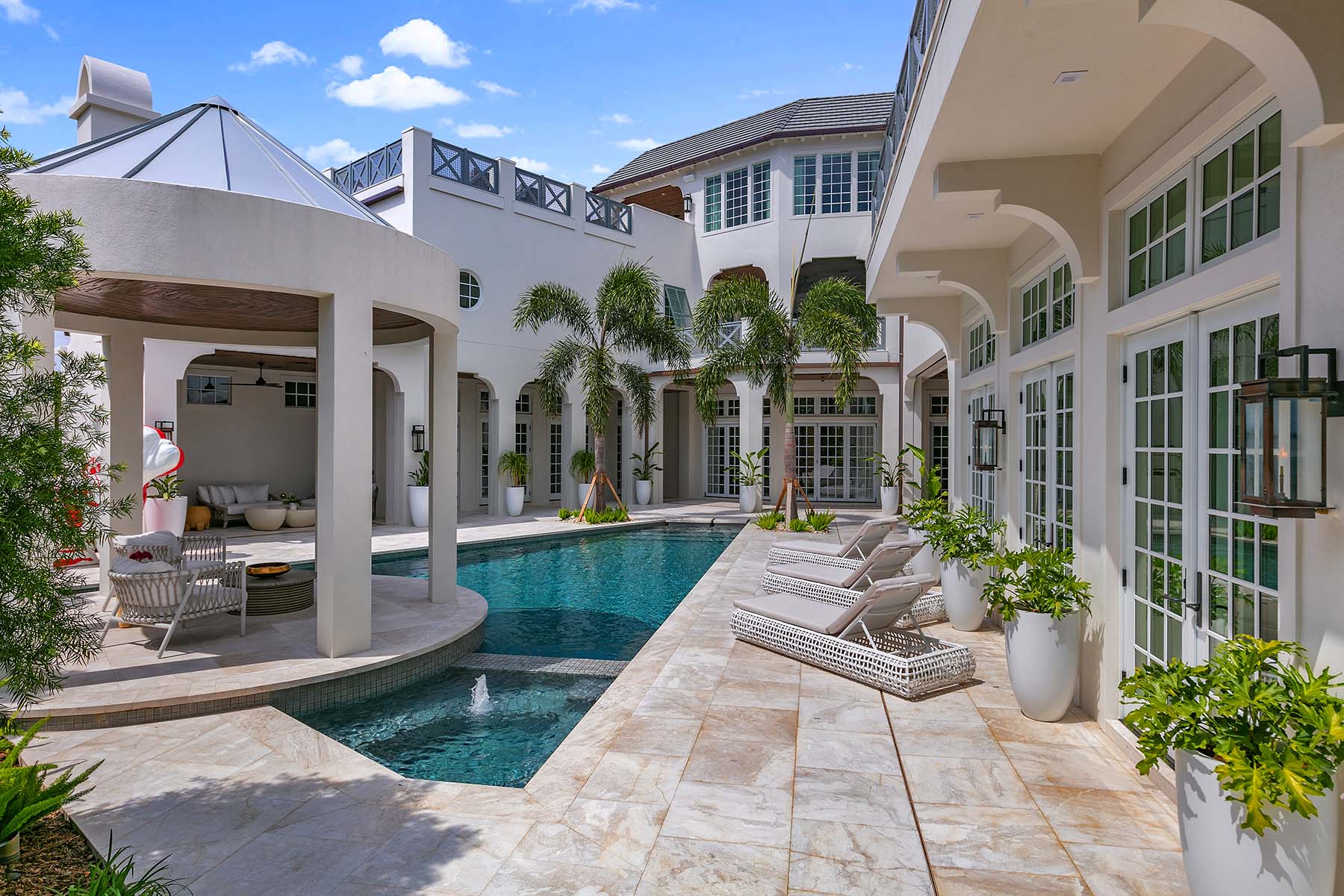
The work itself demonstrates what that integration makes possible. When Kean encountered a nearly one-acre property facing a lake with golf course views in Orlando, he conceived a dual-courtyard estate whose organizing idea was total transparency: “The concept of this home was that all of the glass would disappear and the house could live inside and out.” That ambition, glass that dematerializes and boundaries that dissolve, is precisely what the courtyard form enables. The living room was planned to feel like a glamorous yet intimate boutique hotel lobby, with a massive wall of windows opening to the courtyard before disappearing completely into a wall to create a seamless indoor-outdoor experience.
The modern courtyard residence, as PKDG has developed it across Central Florida, addresses a set of conditions that the mid-century architects would recognize immediately. Lots are often generous but not vast. Neighbors exist. The sun is intense and must be managed rather than simply welcomed. Hurricanes impose structural requirements that make enormous uninterrupted glass spans an engineering challenge. And discerning clients want to feel that their residences are both open and protected, filled with light but not with the gaze of passersby.
A well-designed courtyard plan turns the estate into its own landscape. The building wraps around one or more outdoor rooms, creating a sequence of spaces that moves from public to private without the abruptness of a front door slamming shut behind you. In one Winter Park residence featured in Dwell, the courtyard announces itself at the entry: an enclosed outdoor room clad in ipe, hosting a water feature and drought-tolerant plantings, with wide windows overlooking the secluded space from within the residence. The entry offers a controlled moment of transparency that reveals just enough. Interior rooms open onto the court through sliding glass walls, effectively doubling their usable area when weather permits, which in Florida is most of the year.
The Quality of Light
The courtyard also transforms the quality of light within the residence. Rather than streaming in from one direction, as it does through a conventional window wall, light in a courtyard residence arrives from multiple angles and at different intensities. A deep courtyard produces soft, reflected light on its shaded sides while direct sun illuminates the opposite wall. The effect changes through the day as the sun moves, creating an interior atmosphere that feels alive and varied rather than static. Kean and his team treat courtyards as light wells, positioning rooms around the perimeter according to their need for morning sun or afternoon shade, for brightness or for quiet diffusion.
Water plays a role here that should not be overlooked. In the Orlando dual-courtyard estate, a knife-edge pool designed by Kean appears to merge with the adjacent lake beyond, the pool becoming not just a reflecting surface but a visual extension of the landscape itself. A reflecting pool or lap pool set within a courtyard becomes a secondary light source, bouncing sunlight onto ceilings and soffits in patterns that shift with the breeze. The effect is impossible to replicate with artificial lighting and difficult to achieve in any other configuration. It is one of the reasons that PKDG courtyard residences possess a luminous quality that photography cannot quite capture. You have to stand in the space and watch the light move.
Privacy, Zoning, and the Architecture of Discretion
There are practical advantages as well, though they are less poetic. A courtyard plan naturally separates the residence into zones, making it straightforward to distinguish between public entertaining spaces, private bedroom wings, and service areas. In the Orlando estate, a palm courtyard designed with landscape architect Corey Mills is easily accessed from three art-filled guest suites, each zone given its own relationship to the outdoor space and its own degree of openness or enclosure. A principal suite might open fully onto a private section of the courtyard, screened from the rest of the property by a garden wall or a change in level.
The courtyard also provides a protected outdoor room that functions in weather conditions that would make an exposed terrace unusable. The surrounding building mass blocks wind. Deep overhangs shed rain. In hurricane country, a courtyard can be designed so that its glass walls are recessed behind the structural envelope of the residence, allowing them to be lighter and more transparent than they could be on an exterior facade where impact-resistance ratings apply. PKDG’s commitment to green building practices, as one of the most experienced LEED-certified builders in Central Florida, means this structural intelligence is paired with sustainable construction methods that extend the life and efficiency of every property they deliver.
Form Follows Intelligence
This last point deserves attention because it illustrates something important about how great architecture works and why PKDG’s integrated design-build model is so well suited to the courtyard form. The courtyard is not merely an aesthetic choice or a historical reference. It is a strategy that resolves real conflicts between light, privacy, climate, and structure. Beginning with a worldview of architecture that incorporates design for specific locations and topography, each PKDG commission is one-of-a-kind and customized to satisfy the distinctive requirements and unique lifestyle of each client. The privacy is inherent in the plan, not applied as an afterthought with hedges or shutters. The light is shaped by the architecture itself, not corrected with blinds and dimmers. The hurricane protection is structural, built into the geometry of the building rather than bolted onto its surface.
There is a temptation in contemporary architecture to treat the courtyard as a luxury gesture, a water feature surrounded by frameless glass staged for a magazine shoot. But the courtyard’s real power lies in its ordinariness, in the way it organizes daily life around a center of light and air. The finest examples feel less like architectural statements than like residences that have simply found a sensible way to sit on their land. They face inward not out of introversion but out of intelligence, offering their inhabitants the thing that every truly great residence should provide: the freedom to live openly within a space that feels entirely their own.
The Standard for Central Florida’s Most Discerning Clients
In Central Florida, where the tension between openness and enclosure is written into the climate itself, Phil Kean and the Phil Kean Design Group have made the courtyard their own. Since 1984, Kean has helped clients design and develop the residences of their dreams, accumulating along the way a body of work that proves the courtyard is not a nostalgic gesture but a living response to real conditions. Their commissions ask residents to think about sequence and threshold, about the way light changes as you move from room to court to room again. They ask that attention of the architecture itself, designing not just walls and roofs but the spaces between them. And they reward that attention with residences that feel, in the best sense of the word, complete.