The floor changes underfoot. Porcelain gives way to stone. The ceiling is gone. The air is different. You have crossed from inside to outside without noticing, which is the point. In a Phil Kean home, that threshold is designed to vanish.
But something has to be waiting on the other side of the glass. The terrace, the pool, the garden, the view: somebody has to design all of that with the same care that went into the kitchen and the master suite. That somebody is a landscape architect, and in the Phil Kean process, their work begins months before a single plant goes into the ground.
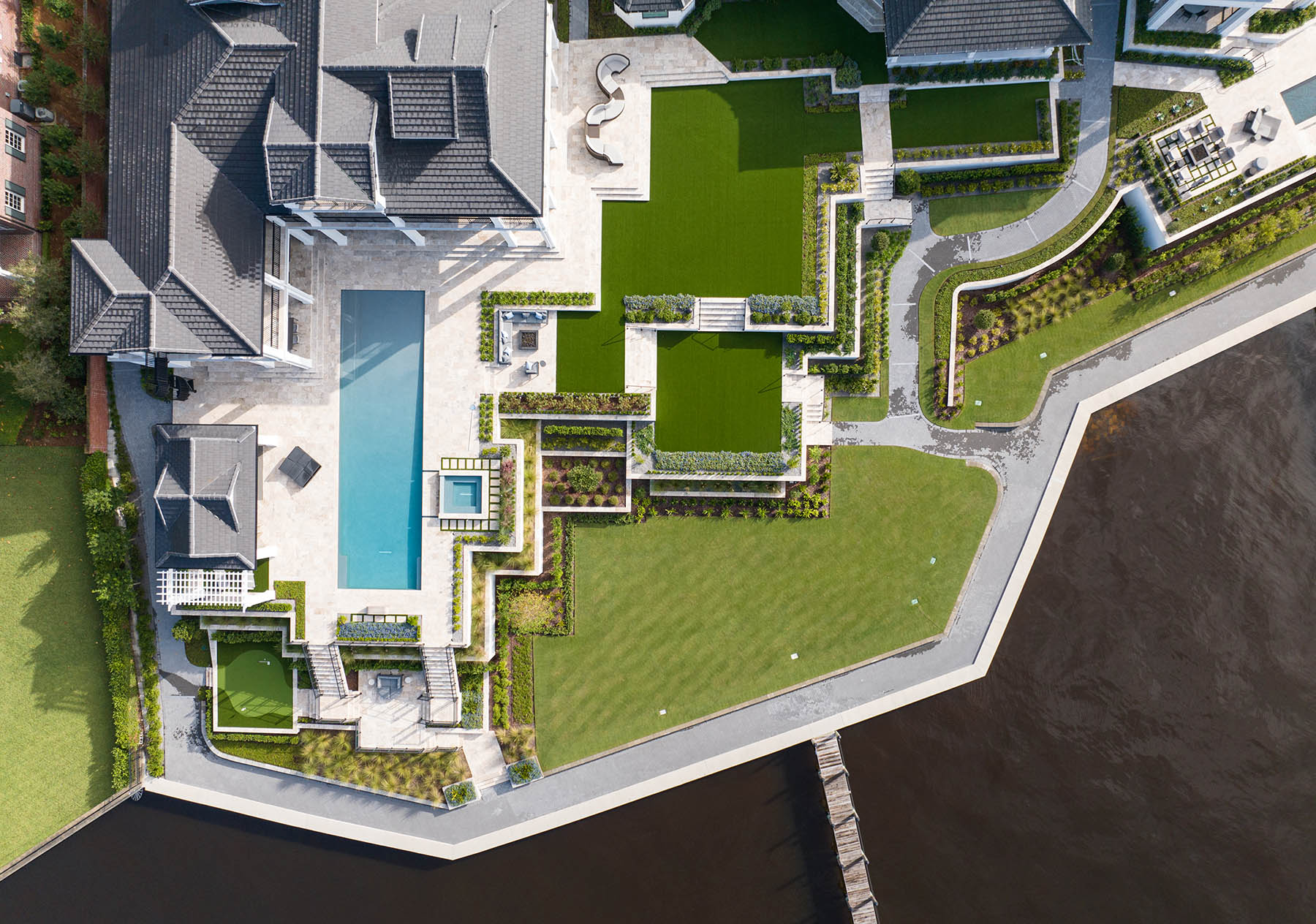
Phil Kean Design Group has worked with Scott Redmon of the Redmon Design Company for over twenty years. Redmon describes what he does in plain terms: “We do what an architect and an interior designer do for the house, but we do it for the outside.” In practice, this means Redmon and his team are responsible for grading, drainage, retaining walls, pool design, hardscape materials, irrigation, and planting, everything from the foundation outward to the property line.
Why It Starts Early
Most homeowners call the landscape architect after the house is framed. By then, the elevation is set, the driveway is locked, and whatever vision they had for the backyard has to fit inside constraints that could have been avoided.
Phil Kean brings the landscape conversation into the schematic phase. The house position on the lot, the finished floor elevation, the relationship between living spaces and outdoor areas: these decisions are made with landscape input at the table, not after the fact.
Here is why that matters. In Central Florida, many jurisdictions limit how far a swimming pool can sit above natural grade. A homeowner might spend a year working with the architect on renderings that show the pool level with the main living area, a vanishing edge looking out over the yard. Beautiful on paper. But if the lot slopes and the code restricts pool height, that concept dies at the permit stage. The house could have stepped down with the grade. The architecture could have accommodated the restriction from the beginning. But nobody asked the right question early enough.
In a Phil Kean project, somebody asks. “Ideally the sooner landscape architects get involved, the better,” Redmon says. “We’re dovetailing into natural systems and environments that architects and interior designers don’t deal a whole lot with beyond sun angles and solar orientation.” His role is to flag those issues before they become problems, and the Phil Kean process gives him the room to do it.
Continuous Surfaces
Phil Kean’s architecture is known for erasing the line between indoors and out. Retractable glass walls, flush thresholds, sightlines that run unbroken from the kitchen island to the pool edge. These are architectural achievements. They also place extraordinary demands on what happens outside that glass.
The interior designer picks a tile. The landscape team matches it with a compatible paver. The architect engineers the opening between the two. In a Phil Kean home, these three decisions happen in coordination, because any disconnect is visible from sixty feet away.
Redmon frames it from the homeowner’s perspective: “When you’re standing inside your kitchen looking at your pool area, there’s your rich materials in your kitchen that need to be spread all the way across your view.” He pauses. “We describe pools as fountains that people sometimes swim in.”
The pool, in this context, is a piece of the architecture. Its shape, its edge profile, its color, its position relative to the house: all of that is part of the composition that Phil Kean is orchestrating. The landscape architect executes the outdoor portion of that composition. The vision comes from the overall design.
Materials That Last
Stone remains stone. Steel holds its shape. Plants do not. They grow, they spread, they die. A landscape architect works with a material palette that changes every season, which introduces a problem no other design discipline faces in the same way.
Redmon has a rule for clients who need to prioritize. “Plants will grow into nicer plants. Your pool deck will never grow into a nicer pool deck.” Spend on hardscape first. Get the underlayment right. Specify the crack-resistant membranes. Use the proper drainage details. The planting can start modest and mature over a few growing seasons. A compromised pool deck will look compromised forever.
This thinking fits the broader Phil Kean philosophy: build it right the first time. The same discipline that goes into waterproofing and structural detailing applies to the landscape. A beautiful property that falls apart in five years is not a successful project.
Maintenance is part of the calculation. Redmon has seen every failure mode Florida can produce. The natural stone that stains from pool chemicals because nobody explained the ongoing sealing schedule. The fountain that becomes a planter because the pump maintenance was never budgeted. The exotic tropical planting that dies in a freak freeze because nobody hedged with cold-hardy species in the privacy screen. “How many people do you want on your property taking care of things when you’re trying to enjoy it?” he asks. It is a practical question, and the answer shapes every specification.
Native Plants, Modern Lines
In 2012, Phil Kean Design Group built The New American Home for the NAHB International Builders’ Show in Orlando. The landscape was composed entirely of native Florida plants, endorsed by the Florida Native Plant Society, arranged in clean geometric lines. Not a wildflower meadow. A modern, sculptured composition using species that evolved in this climate.
The project won multiple awards. More importantly, it proved something the firm already believed: you do not have to choose between environmental responsibility and contemporary design.
Native plants bring the property to life in a way imported ornamentals cannot. They attract native pollinators, native birds, native butterflies. “If you have a native plant in the back of your truck, you’ll have butterflies and birds following that truck,” Redmon says. “It’s like magic.”
A generation of younger luxury homeowners is arriving with this sensibility already in place. They want modern architecture, seamless indoor-outdoor living, and a landscape that belongs to Florida rather than fighting it. Phil Kean has been building that way for years.
The Front Door Test
Redmon has lived in his own house for thirty years. When he looks out his front door, he does not see his neighbors. He does not see the street. He sees a garden.
When he suggests the same approach to clients, they sometimes push back. “Oh my God, I just spent four million dollars and you hid my house.” They want the street to see what they built. Redmon understands that. He does not force his preference.
But the instinct behind it aligns with something Phil Kean has always understood. A home is designed for the person who lives in it. The front yard exists for the person walking out the front door, not for the neighbor driving past. The backyard exists for the family eating dinner on the terrace, not for the drone photographer.
When the landscape is designed with the same intention as the architecture, when both are conceived together from the very first conversation, the entire property becomes a single experience. The house meets the land. The land answers back. And the threshold between the two, that moment where the floor changes and the ceiling disappears, becomes the most effortless part of the whole composition.