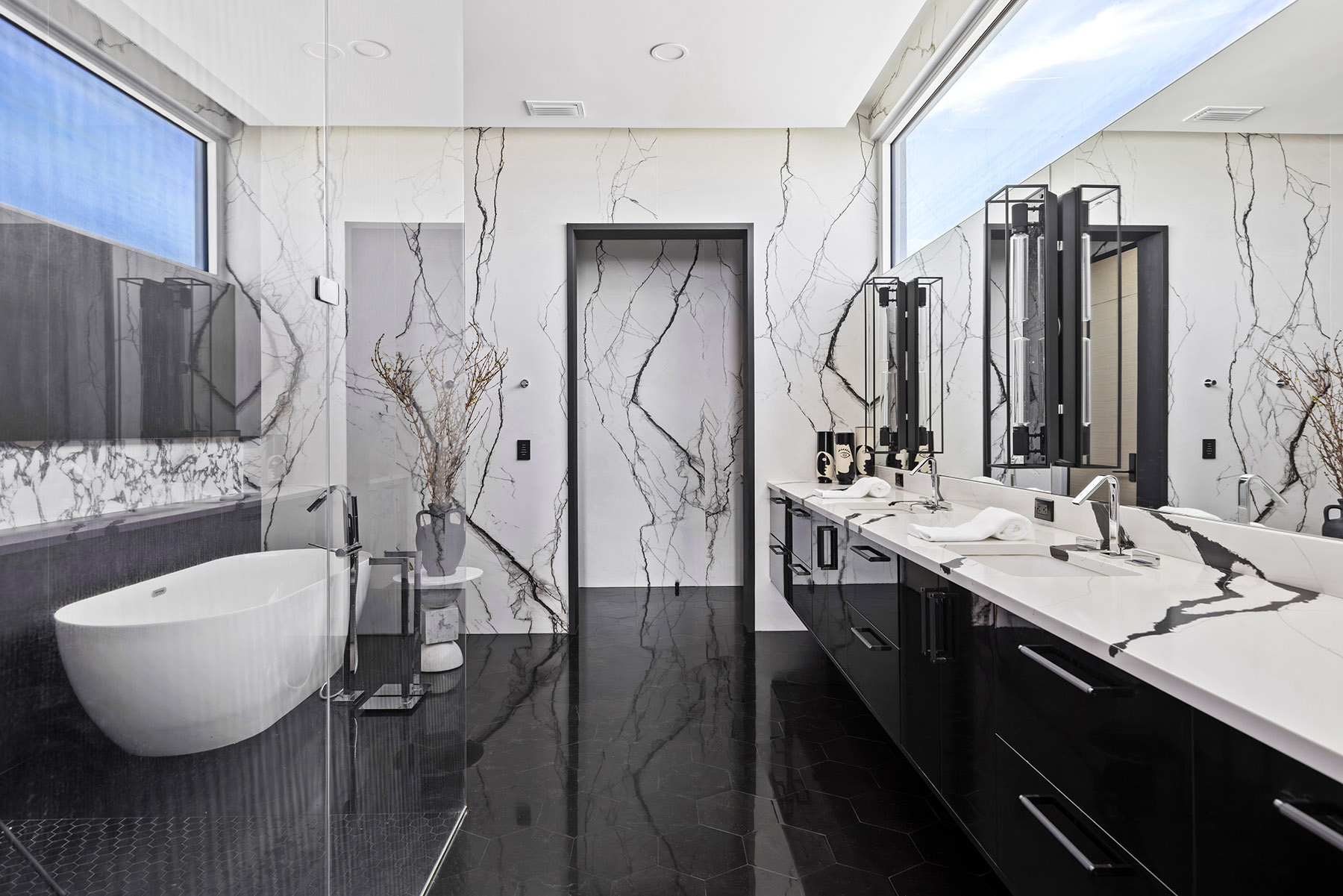
There is a moment in the construction of any great home, still months before the furniture arrives, before the chandelier is hung, before the family moves in, when a trained eye can already see the finished space with perfect clarity. For Annette DePaepe, Senior Interior Designer at Phil Kean Design Group, that vision is a hard-won discipline: the earned result of decades spent studying how architecture, material, light, and human personality converge to produce a life well lived within a beautiful home.
DePaepe operates at the highest register of residential design, where the margin for error is vanishingly small and the stakes, financial, emotional, and aesthetic, are correspondingly large. Her work unfolds across the full arc of a project, from the earliest structural conversations with architects to the placement of the last accessory on the dining room table. What she practices is spatial storytelling, a form in which every surface, every transition, every cone of light is a considered sentence in a larger narrative authored for and with each individual client.
Drawn to the Discipline
DePaepe’s trajectory into luxury residential design was, in retrospect, almost inevitable. From childhood, she was instinctively attuned to the visual world around her: the geometry of skylines, the particular beauty of a flower, the endless possibility of a rearranged room. When it came time to formalize that sensibility into a vocation, she began with architecture, earning a degree in architectural drafting and developing a rigorous fluency in structure and form.
It was during a subsequent year of broader artistic exploration, drawing, painting, art history, that the specific contours of her calling came into focus. In one memorable still-life class, while her peers gave themselves over to abstract invention, DePaepe instinctively mapped the composition with architectural precision, working carefully within the laws of scale and proportion. Looking at the imaginative work around her that day, she realized something clarifying: she needed the discipline of a defined framework. She needed the canvas, and she needed the walls.
Interior design, she understood immediately, was exactly that: a domain of genuine creative expression held in productive tension with structural reality. “I needed a little confines, but I still wanted to have that ability to create and have half of a blank canvas,” she reflects. That balance, the freedom within the given, remains the animating principle of her practice today.
Before joining Phil Kean Design Group, DePaepe accumulated experience across the full spectrum of the industry: office design, architectural drafting, staircase detailing, millwork, furniture sales. Each chapter added a layer to her understanding of how interiors are designed, built, and inhabited. What she found, ultimately, was that the design-build model was uniquely suited to the way she thinks and works. It is the one context in which she could follow a project all the way from its earliest structural decisions to its final, fully inhabited moment.
From Blank Concrete to Lived Space: The Full Scope of the Work
Ask Annette DePaepe what interior designers actually do, and she will gently dismantle whatever preconceptions you brought to the question. The work begins with people.
“It’s really just a searching and seeking game to try to understand the intent of the architecture and really getting to know the clients themselves,” she explains. Those first meetings are deliberately kept open, with rough sketches and inspiration images chosen to start conversations rather than foreclose them. The real intelligence gathering happens in less formal settings. DePaepe schedules what she calls shopping trips: visits to appliance showrooms, plumbing suppliers, tile galleries. Hours spent side by side with clients, apparently browsing, and truly listening.
The method is deliberate and reveals its value almost every time. On one recent project, a client was calmly selecting a grill, an easy and expected choice, when the conversation drifted toward something entirely different: a pizza oven. The client began describing the chef friend who would come to cook for golfing companions, the grandchildren who would gather around the dough, the ritual of family and hospitality that this single element could anchor. “I would have never known that,” DePaepe says. The pizza oven made it into the design.
This is the first discipline of luxury residential design: learning to hear what clients have yet to articulate. The second is translation, turning that understanding into spatial decisions of lasting consequence.
Once the design conversations begin in earnest, the process moves through the home systematically and with great methodological care. Rough layouts address the large-scale questions first: kitchen and bathroom configurations, the placement of fireplaces, structural implications of ceiling treatments, the logic of how rooms flow into one another. At Phil Kean Design Group, where the architecture team and interior designers share an open studio environment, these decisions are made in genuine collaboration, with a project manager, a structural question, and a quick sketch across the office resolving in minutes what would otherwise require a labored exchange. The intimacy of that working relationship is inseparable from the quality of the output.
From those broad strokes, the design dials down progressively: space by space, surface by surface, material by material. Tile selections, millwork profiles, door hardware, cabinetry details, and countertop edges are each considered in relation to every adjacent decision. “The more luxury,” DePaepe observes, “the more important it is that everything flow from one space to the next, from one finish to the next.”
The process concludes with FF&E, the furniture, fixtures, and equipment that will populate the completed shell, and even here DePaepe’s involvement extends further than most clients expect. Bedding is sourced. Artwork is selected. Accessories are curated and placed. The goal, always, is the same: that when a family arrives at their new home, the only thing left to do is unpack.
Interior Detailing: The Language Beneath the Surface
Among the most revealing aspects of DePaepe’s work is what the industry calls interior detailing, the comprehensive specification of every fixed surface within a space. She offers a clarifying analogy: if you could pick up the home and turn it upside down, everything that fell out would be furniture and accessories. Every ceiling plane, every wall treatment, every floor transition, that is the domain of interior detailing.
At Phil Kean Design Group, where the homes are defined by their open, flowing plans and their seamless relationship to the Florida landscape, ceilings are among the most consequential design decisions a project will involve. Here, ceiling planes become the architectural grammar by which distinct zones within an open plan are identified and given character. The volume over a dining table reads differently from the volume over a kitchen island; the canopy above a bed holds a different quality from the ceiling over a sitting area. These decisions require advance coordination with the architectural team, because the structural implications of concealed lighting coves, built-in niches, and custom-formed ceiling planes must be resolved long before a nail is driven.
Equally critical is the handling of accent walls, material transitions, and the logic by which exterior elements are carried into interior space. In one recent project that DePaepe describes with evident satisfaction, the exterior of the home featured a combination of stucco and fieldstone, an unconventional pairing that leaned slightly rustic against an otherwise modern sensibility. Rather than treating the interior and exterior as separate visual systems, she drew the stone inward from the moment of entry. Visible through the glass at the front door, it traveled across the fireplace wall and through to the rear of the home. The flooring, meanwhile, was matched to the pool-surround pavers outside. When the architects’ glass walls were opened and stacked, the distinction between inside and out simply dissolved. The kitchen counter material extended seamlessly to the outdoor kitchen. It was, she says simply, “one big living space at that point.”
The Paintbrush and the Paint
DePaepe’s design philosophy is rooted in collaboration rather than imposition. The relationship, in her framing, is more generous and more humble than the conventional image of the decisive creative director. “I feel like I’m the paintbrush,” she says, “but they’re the paint.”
The conviction behind that metaphor runs deep. Great residential design is a living art, one that must accommodate the morning routine and the dinner party, the quiet evening and the birthday celebration. It must grow with a family and remain beautiful as it does. The designer’s role is to translate the client’s truest self, including dimensions the client has yet to fully articulate, into spatial form.
In practice, this means DePaepe works across an extraordinary range of client sensibilities. One current project involves a client she describes, with warm amusement, as her “Disney client”: someone who loves primary colors, humor, and the element of surprise. For her, DePaepe is designing a space that maintains the streamlined discipline of the home’s modern architecture while introducing moments of visual delight at every turn, a wall of pink in the personal desk area, a retro fixture overhead, a corner that rewards the curious. On another project, running simultaneously, the brief calls for peaceful surroundings, minimal furniture, a monotone palette, and the architecture itself as the primary experience.
Both are equally valid. Both require the same quality of listening.
The design must also endure. DePaepe approaches the fixed elements of a home, the surfaces that call for permanence, with a strong bias toward the timeless. Neutrals. Natural materials. Layered textures and mixed metals that create visual richness through depth rather than trend. “I try to keep all of the hard surfaces timeless,” she says. The elements that can evolve, furniture groupings, area rugs, art, even a chandelier, are selected with enough flexibility that they can be refreshed as a family’s life changes, allowing the space to adapt gracefully alongside it. The bones remain beautiful; the expression of them evolves.
Light as Architecture
Of all the elements that homeowners underestimate, DePaepe returns most frequently to one: lighting. She approaches it as a design medium as significant as stone or timber, a force as capable of shaping experience as any structural wall.
The distinction, she explains, lies in treating light as an ambient and emotive presence rather than a purely functional task. A system of carefully considered light, with cove sources that wash surfaces while keeping bulbs gracefully concealed, directional beams that animate texture, and accents that pinpoint artwork at the end of a corridor, transforms a room into an experience that changes character through the day.
Planning for that kind of lighting begins on the drafting table, long before construction. Structural trusses must be fabricated to accept concealed coves. Ceiling details must anticipate apertures. The coordination between interior designer, architect, and often a specialist lighting consultant must happen early, because the structural decisions made at that stage define the space permanently.
The ambition of DePaepe’s current approach to lighting is perhaps best illustrated by a project now underway: a custom chandelier conceived entirely around the experience of light rather than the hardware of it. Working with glassblowers in the Czech Republic, she is commissioning a series of hand-blown glass sculptures to be suspended from the ceiling of a significant room. Tiny LEDs, hidden above them in the structure, will cast light downward onto the pieces. The glass will shimmer and glow and reflect, becoming, in effect, a source of radiance, with pure beauty on view and the mechanics gracefully concealed. The result will be, simultaneously, a work of art, a lighting solution, and an argument for what luxury design can accomplish when imagination and craft are given room to collaborate.
What “Better Than Imagined” Means
The measure of success in Annette DePaepe’s work is singular and specific: the moment a client moves into a completed home, invites her back, and says, with evident emotion, that this is better than they ever imagined.
“That’s just like, I want to do it again and again,” she says. The creative challenge, the solving of the spatial puzzle, the long months of decision-making and material selection, all of it distills, in the end, to that: a family in a home that feels entirely, unmistakably their own. A life given a beautiful setting.
That is what Annette DePaepe builds. And it is why, at Phil Kean Design Group, the work is always, fundamentally, about the people who will live within it.
To explore the portfolio of Phil Kean Design Group and see the work described in this feature, peruse our portfolio of luxury modern home interiors here at PhilKeanDesigns.com/interiors.